

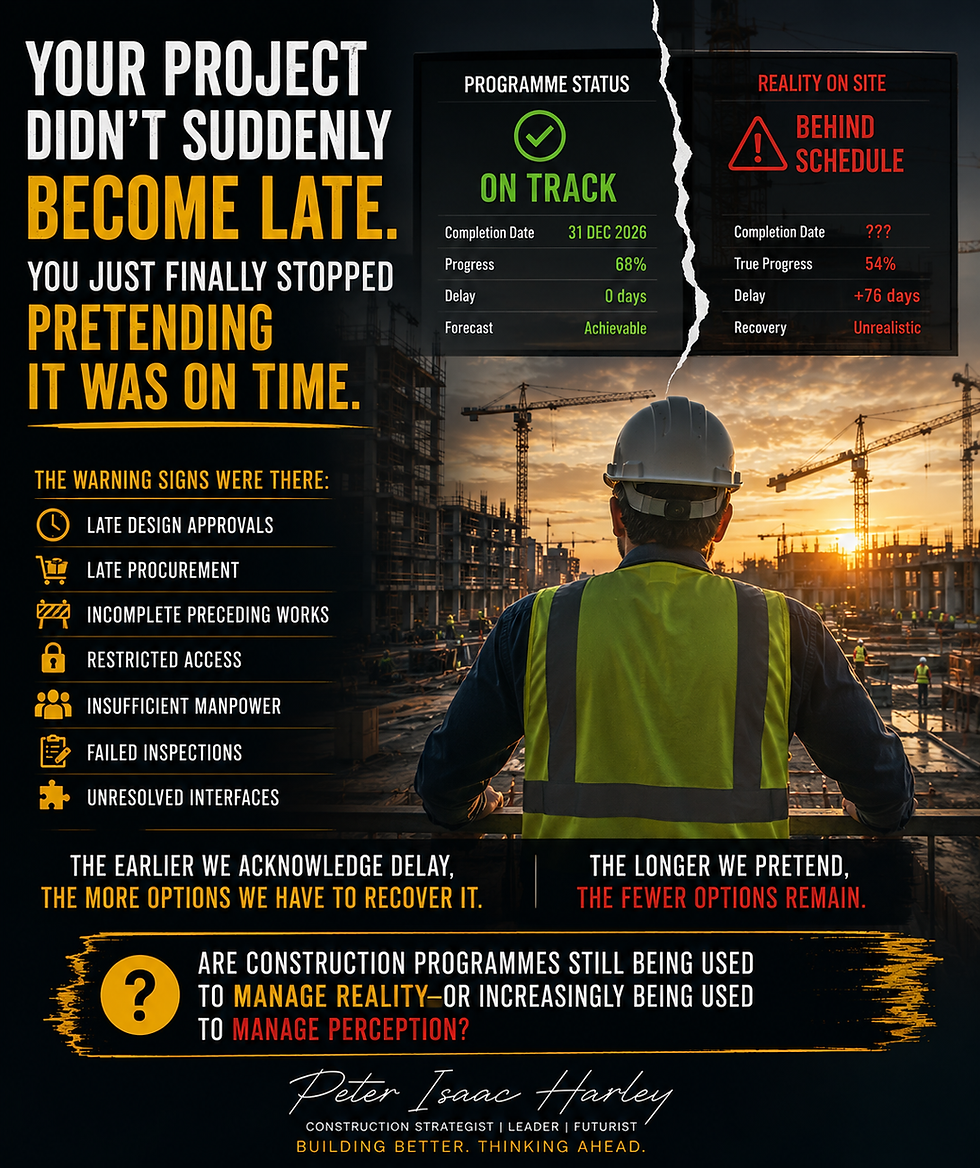
YOUR PROJECT DIDN'T SUDDENLY BECOME LATE. YOU JUST FINALLY STOPPED PRETENDING IT WAS ON TIME.

YOUR PROGRAMME IS ALREADY LATE. EVERYONE IS JUST PRETENDING IT ISN'T.
Construction projects rarely become late at the end.
They become late months earlier.
The programme just takes longer to admit it.
The Planner knows.
The Construction Manager knows.
The subcontractor definitely knows.
Sometimes even the client knows.
Yet the report still says:
"Completion date remains achievable."
How?
By adding more manpower that isn't available.
By compressing activities that cannot realistically be compressed.
By assuming every material will arrive on time.
By pretending lost time will somehow be recovered later.
And by moving unfinished work into next week's look-ahead.
Week.
After week.
After week.
Until eventually, reality wins.
Then suddenly everyone asks:
"How did the project become so delayed?"
It didn't suddenly become delayed.
The warning signs were there.
Late design approvals.
Late procurement.
Incomplete preceding works.
Restricted access.
Insufficient manpower.
Failed inspections.
Unresolved interfaces.
The project was telling us the truth all along.
We just didn't want to report it.
A programme should not be a document designed to protect the completion date.
It should be a management tool designed to protect the project.
There is a difference.
Because the earlier we acknowledge delay, the more options we have to recover it.
The longer we pretend...
The fewer options remain.
So here's my question to the industry:
👇 Are construction programmes still being used to manage reality—or increasingly being used to manage perception?


Comments